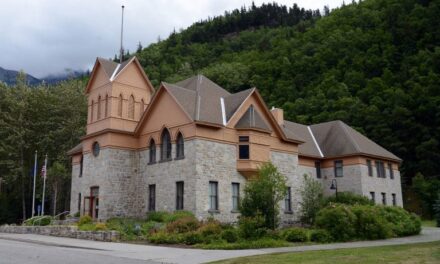
KHNS needs a volunteer this Thursday June 20th. Someone to load a car onto the 1:30pm ferry in...
On Air
Submit and View KHNS Postings
Please use the following links to submit or view on-air messages :
Submissions must be approved and may be edited for content before appearing on the website or read on-air. If you would like a confirmation, please email the station at khns@khns.org. LPs are processed as soon as possible, please allow 3-5 days for process of PSA's . If submitting after 5pm or over the weekend announcements will not be approved until the following weekday.
From Our Listeners
-
-
Judy Ewald has the blue ribbons for the Women's 8-person team Totally Tubular of Skagway....
-
Flying in to Whitehorse July 1st. Must be in Haines by the 4th. I can help with gas money,...
Thanks to our Generous Underwriters, Sponsors and Grantors
Image galleries
Southeast Alaska News
State planning replacement of Tustumena ferry
KODIAK — The state of Alaska is planning to replace a ferry that serves Kodiak and southwest Alaska but has been out of service for repairs since November.
The 49-year-old vessel Tustumena had been scheduled to return to service in April but that date was pushed back to July.
“If that boat gets seriously delayed, we really feel it’s very important that we replace it as quickly as we can,” marine highway system general manager John Falvey said.
UAF professor disputes Ice Classic record
FAIRBANKS — A University of Alaska Fairbanks professor is disputing the claim that this year’s Nenana Ice Classic culminated with the latest river breakup in the history of the 97-year-old guessing game.
The Tanana River ice moved at 3:41 p.m. Monday. The game of guessing when the ice will move officially uses standard time, not daylight time, so the winning time was listed as 2:41 p.m., breaking the record of 11:41 a.m. AST set May 20, 1964.
News team!
KCAW’s Anne Brice and Robert Woolsey following the tri.
Raven Radio established itself as a force to be reckoned with in local endurance sports by capturing 2nd place (1:50:40) in the corporate category of the 29th annual Julie Hughes Triathlon last weekend (5-18-13). Post-graduate fellow Anne Brice (run) and news director Robert Woolsey (bike, swim) spent months developing the core strength and stamina needed to challenge the category favorite Hames Center (1:24:31), whom they lost to by a mere fraction of an hour. The near-victory proves that Raven is not only a black bird, but also a dark horse on wings.
Sitkan Jonathan Kreiss-Tomkins was the overall winner in this year’s JHT, posting a time of 1:25:57. The top solo woman was Emily Davis at 1:40:24. In the youth division, Joe Pate had the top time of 34:31. Skylar Moore was the top girl at 36:35.
See the complete results from the 29th annual Julie Hughes Triathlon.
Listen to Bill & Carol Hughes and Suha Tokman discuss the history of Alaska’s oldest triathlon on Sitka Sports with Mike Vieira.
Kayhi students observe underwater survey
Gary Freitag works the controls for the underwater Remote Operated Vehicle while Ketchikan High School oceanography students watch the ROV’s live video feed.
Students in a Ketchikan High School ocean science class had a unique field trip a couple weeks ago. They went out on the school-owned training boat to nearby Ward Cove, performed some chemical tests and watched a live video feed of the cove’s murky, desolate bottom.
On a cloudy, brisk, somewhat windy day, as the school year winds down, some maritime training students practice running the school-owned Jack Cotant as a Kayhi Ocean Science class rides along to Ward Cove for a day of investigation.
“Oceanography is one of two ocean science classes at Kayhi,” said Ocean sciences teacher Julie Landwehr. “We have marine biology and oceanography. We study a lot of the physical
Kayhi oceanography students test the water at Ward Cove during a field trip on the F/V Jack Cotant.
characteristics of the ocean, things like currents.
This is the one big field trip for Landwehr’s class of mostly seniors. They’ve gotten outside for other tests closer to home, with weekly phytoplankton monitoring at the docks, and keeping an eye out for algae blooms.
But this trip lets them apply more of the skills they’ve learned in class, and in a different location. Ward Cove is interesting because it’s the site of the former pulp mill, and likely has been affected.
Landwehr says she’s excited for the students to see the bottom of the cove. She expects lots of debris left over from its longtime industrial use. As they’re not a diving class, the method for examining the bottom is an ROV, a remote operated vehicle, which is operated – remotely – by Gary Freitag, the Ketchikan Marine Advisory Agent for the University of Alaska Fairbanks Sea Grant Program.
Freitag and Ketchikan-based Oceans Alaska put together a state grant to buy the ROV for marine debris survey work. He says the compact submarine device is capable of diving about 800 feet, sends back real-time video, and has a manipulator arm that can lift up to 200 pounds.
“It’s got thrusters that allow it to do forward and back, up and down, auto heading and depth settings, lights, color camera with focus adjustments,” he adds. “It’s quite a unique little machine and it’s really easy to carry. It’s only about 30 pounds.”
Freitag’s done a few surveys already, and says they found a tremendous amount of debris, but so far no obviously dangerous discarded fishing gear. They did bring up an old rusty mailbox, because the door was still on it and it could trap marine animals, and they identified some old tires that should be removed at some point.
The grant to buy the ROV included an educational component, which was partly why he and Barbara Morgan of Oceans Alaska are out that day with the Kayhi students.
“The intent of it is to do marine surveys, looking for ghost fishing gear, and to expose students to the idea that good stewardship is the way to go, not just throw things over the side,” Morgan said.
Marine science teacher Julie Landwehr shows a pH test for water at Ward Cove.
The trip from Bar Harbor to Ward Cove doesn’t take long. Soon the maritime students tie the Jack Cotant up to the Oceans Alaska barge, and the ocean science students get out their gear to start testing the cove.
They looked at salinity, turbidity, plankton, dissolved oxygen, and temperature. Then, Freitag shows them an old-fashioned clamshell trap that they use to collect a soil sample from the bottom.
They send the trap down and get a small handful of mud. It isn’t particularly interesting to look at, although Freitag makes sure to give it a good sniff.
“If it smells like rotten eggs, it means it’s anoxy, which means there’s no oxygen,” he said.
Those are all initial tests before the star of the trip makes its appearance. Freitag and Morgan lift the ROV out of its case, start its generator (cue generator sound) and send it down. The result is a little anticlimactic.
“It’s pretty barren,” Freitag says, as Landwehr exclaims over the lack of debris.
There’s not much to see, and the students are starting to look bored. Luckily, the exploration is cut short when a thruster sucks up some debris.
Once Freitag fixes the ROV, they don’t bother sending it back down into Ward Cove.
Julie Landwehr and Gary Freitag look at a crinoid that the Remove Operated Vehicle brought up from the bottom of Tongass Narrows.
Instead, the maritime students and their teacher untie the boat and motor a short distance across the narrows, so everyone can see the contrast between a damaged and a healthy ocean floor.
As soon as the ROV hits bottom, the difference is obvious, with an abundance of curious rockfish and a variety of starfish-type critters.
“There’s all kinds of sea stars here,” Freitag said, also pointing out a sea pen and a crinoid. “The one on the left in a crinoid and the one on the left is a sea pen. Those are really neat animals.”
Freitag uses the ROV’s arm to grab some of the crinoid’s limbs, and brings them up for closer examination. The orange, spindly fingers have an alien appearance, and Landwehr slips them into a sample bag to take back to school.
More fodder for eager science students.
Barbara Morgan holds the Remote Operated Vehicle after bringing it up with a crinoid sample in its manipulator arm.
Wed May 22, 2013
Listen to iFriendly audio.
Gov. Parnell leaves most SE capital project funding intact, but deducts $5-million planned for Mt. Edgecumbe pool. Sitka father, son plan run across America to protest genetically-modified foods. Juneau forestry lab dedicated.
Weather predictions for Southern Southeast
Rick Fritsch, a lead forecaster with the National Weather Service in Juneau looks at weather trends in the Ketchikan Area and discusses Global Climate Change. The interview with Fritsch took place May 14th. Part 1 looks at climate change. Part 2 is an extended interview on local weather trends that aired on Morning Edition.
Commentary: Sitkans should care about GM foods
The opinions expressed in commentaries on Raven Radio are those of the author, and are not necessarily shared by the station’s board, staff, or volunteers.
Brett Wilcox
My son, David, and I will run across America in 2014 to raise awareness of genetically modified organisms.
When I tell people about Monsanto and genetically modified foods or GMOs, the most common response I hear is, “What’s Monsanto?”
Monsanto is a multinational corporation based in St. Louis, Missouri. Prior to the year 2000, Monsanto was best known for its production of PCBs, DDT, and Agent Orange, products Monsanto declared safe long after their own employees’ ill health and premature deaths proved otherwise.
Monsanto and other biotech companies make genetically modified seeds by forcing the genes of unrelated species, most often bacteria and food plants, together through crude and imprecise methods. U.S. law allows these unnatural creations to be patented.
Monsanto licenses their patented seeds to farmers the same way a software company licenses software to computer users. If farmers save and replant licensed seeds the way they’ve done for thousands of years, Monsanto sues these farmers and wins in court.
So what? Why should Sitkans care about farmers, lawsuits, pesticides and GMOs? Here are 5 good reasons:
1. GMOs have resulted in increased use of pesticides. Pesticides are poisons. Farmers wear hazmat suits when they spray the poisons on the plants you feed your kids. Pesticide poisoning results in reproductive issues such as infertility, miscarriage, birth defects, and various cancers.
2. The process of genetic modification produces massive collateral damage to the plant cells which results in unpredictable and potentially lethal results. 1,500 people developed serious illnesses and 37 died in 1989 after ingesting the genetically modified food supplement, L-Tryptophan.
3. Key Monsanto and government personnel routinely swap offices, passing through what is known as the revolving door. Naturally, this makes our government pro-biotech. A pro-biotech government is far more likely to approve genetically modified salmon than a pro-citizen government.
4. Pesticides and GMOs kill bees. The EPA approves bee-killing pesticides banned in the EU. Einstein said “If the bee disappeared off the face of the earth, man would only have four years left to live.”
5. Most of us eat GMOs and we don’t know it because our pro-biotech government refuses to label GMOs, even though they are labeled or banned outright in over 60 countries including China.
Monsanto and GMOs may be one of the most important concerns facing Sitka, the USA, and the entire world. Sitkans are meeting at 7 p.m. May 25 at Centennial Hall to learn more about Monsanto. And Sitkans will meet on Castle Hill, May 25, at 2 p.m. to participate with over 300 other cities in a global March Against Monsanto.
Commentaries are a listener service of Raven Radio. If you’re interested in adding your voice to the mix, click “Contact Us” in the orange bar above, and send a message to our news department.
Panel collects details of Shell drill ship towing procedures
ANCHORAGE — A towing plan for a Royal Dutch Shell PLC drill barge crossing the Gulf of Alaska in December called for moving the vessel to a protected bay or heading for deep water if an extreme storm hit, the official who approved the plan said Tuesday.
Norman “Buddy” Custard, the Shell Alaska operations manager for the tow, said the company reviewed historic storm data and gave the go-ahead for the 18- to 24-day voyage in mid-December despite having a weather forecast out only 72 hours.
Some found guilty in Native fishing case
BETHEL— A Bethel judge has ruled against some of nearly two dozen Yup’ik Eskimo fishermen cited for illegally fishing king salmon in the Kuskokwim River during a poor run last year.
Several of the fishermen were found guilty Monday after their trials by judge resumed. Magistrate Bruce Ward adjourned the cases last month until he could determine whether the fishermen have a spiritual right to fish for king salmon when restrictions are in place, as they claim.
Governor signs oil tax, budget bills, vetoes $2.5M
JUNEAU — Gov. Sean Parnell on Tuesday signed into law an overhaul of Alaska’s oil tax structure, hailing it as part of an historic legislative package aimed at moving the state forward.
Parnell, who championed the overhaul as a way to increase oil production and industry investment, repeatedly referred to the bill as the “More Alaska Production Act.”
“It’s been an historic year for our state, it’s been a phenomenal year, a comeback year,” Parnell told a crowd at the Anchorage Chamber of Commerce. He said Alaska’s “energy comeback begins today.”
Governor signs oil tax, budget bills, vetoes $2.5M
JUNEAU — Gov. Sean Parnell on Tuesday signed into law an overhaul of Alaska’s oil tax structure, hailing it as part of an historic legislative package aimed at moving the state forward.
Parnell, who championed the overhaul as a way to increase oil production and industry investment, repeatedly referred to the bill as the “More Alaska Production Act.”
“It’s been an historic year for our state, it’s been a phenomenal year, a comeback year,” Parnell told a crowd at the Anchorage Chamber of Commerce. He said Alaska’s “energy comeback begins today.”
Sitka father, son plan Lower 48 run against GMOs
David Wilcox, 14, and his father, Brett, are running across the United States next year. The pair hopes to raise awareness about genetically modified foods, which they say are a danger to the global food supply. (KCAW photo by Ed Ronco)
Note: This story was updated to reflect comment from Monsanto, which was received after our initial deadline.
A Sitka man and his 14-year-old son are hoping to convince you that genetically modified organisms are bad for your health, and for the environment.
Agriculture companies modify the DNA of plants that enter the food supply, to help them grow faster or bigger, or be more resilient to pests. Brett and David Wilcox are channeling their opposition into a demonstration in Sitka this weekend.
The Sitka demonstration is called the “March Against Monsanto.” It coincides with other similar events around the world and is scheduled for 2 p.m. Saturday atop Castle Hill.
But Brett and David Wilcox also hope a big journey next year will help bring attention to their cause.
“We’re going to be running across the country,” says David Wilcox, 14. “We’re starting somewhere in California, and we haven’t really thought of an ending point yet.”
His father, 52-year-old Brett Wilcox, says they’ll include a stop in St. Louis, headquarters to the agribusiness giant Monsanto. The company has become a lightning rod for the debate over genetically modified foods. Among other things, it markets modified seeds to farmers. The seeds are patented and farmers who keep extra seeds for replanting can find themselves taken to court.
That bothers Brett Wilcox, but his bigger worry is about the environmental impact of genetically modified foods. He says his spiritual beliefs are opposed to modified organisms, but also that he has unanswered questions about their scientific safety.
“We’re going to gather seeds from the world, and we’re either going to have them in a backpack and we’re going to carry them as we cross the country, or if we get so many seeds that we put them in a trailer and pull them behind us, we will do that,” Brett Wilcox said. “Those seeds will be the symbol for the run, saying this is why we are running. This is the purpose. We are here to say that we honor these sacred seeds, and we don’t want people messing with them.”
Monsanto is no stranger to the criticisms. The company has an extensive website built entirely to respond to common arguments people make against its practices. One page is titled “Why does Monsanto sue farmers who save seeds?” The company says it’s simply protecting its patents. Another is titled “Farmer suicides in India,” and denies claims that the modified cotton has driven farmers on the subcontinent to kill themselves.
In a written statement, Monsanto spokesman Tom Helscher says the company respects the fact that people can have different points of view, but that the safety of genetically modified crops is well established. The crops undergo federal review by two, sometimes three, federal agencies, including the Food and Drug Administration, the Environmental Protection Agency and the U.S. Department of Agriculture.
“Hundreds of studies in the peer-reviewed scientific literature support the safety of GM crops and there has not been a single substantiated instance of illness or harm associated with their use,” Helscher wrote in an e-mail to KCAW. “The National Academies of Science, the United Nations Food and Agriculture Organization, the World Health Organization and the American Medical Association – among others – have all concluded that GM foods do not pose any more risk to people than other foods.”
The history of agriculture is full of developments in technology — things that have increased the amount of food farmers were able to send to plates. Tractors replaced horses. Fertilizers boosted crops. But Brett Wilcox says what Monsanto and other companies are doing is different.
“What they are producing is not meant to feed the growing population,” he says. “It’s meant to feed cars and cattle. Very little of the research is designed to do anything that would provide any sort of enhanced nutrition. It’s all designed to give them a patent — a legal hold on seeds — so that farmers are then brought into a modern-day slavery system.”
Brett Wilcox says farmers have become too beholden to Monsanto. So, he and David are preparing for their run.
“David has done two half marathons and he’s going to do another half this summer,” he said. “He’ll do his first full marathon this summer for Sitka’s inaugural full marathon. We’re excited about that coming up on August 3rd.”
Brett Wilcox also runs marathons, although he didn’t come to running until his 40s.
“I kind of grew up with the belief that I didn’t have the heart to run,” he said. “That’s not true. I do fine running, and I enjoy it. I’ve done a couple of marathons, and it helps keep me relatively sane.”
The two Wilcoxes plan to leave on their journey sometime in January. They estimate it will take about eight months.
Parnell blocks fund transfer to Sitka pool
Gov. Sean Parnell discusses budget bills in Anchorage Tuesday as Budget Director Karen Rehfeld reviews paperwork.
Governor Sean Parnell left Southeast Alaska project funding intact when he signed the capital budget Tuesday.
But he blocked the transfer of money from one older project to another.
The Legislature’s capital budget called for taking $5 million out of $17 million set aside for a cruise-ship dock in Hoonah. Lawmakers transferred that money to a planned aquatic center in Sitka.
During an Anchorage press conference, Parnell said it was a bad idea.
“That dock is still needed. The growth in passenger traffic, travel-industry traffic, is creating jobs in Hoonah, right down to our high-school age level. That money needs to stay there so they can continue to build their economy there,” he said.
He said it’s unfair to let one town, quote, “rob” another of its capital-project funding.
Sitka’s aquatic center, which has other funding, will be part of the state-run Mount Edgecumbe boarding high school.
Cruise ship passengers board a tendering vessel at Huna Totem’s Icy Strait Point. Lawmakers have funded a new berthing facility, which has not been built. Photo by Ed Schoenfeld, Coastalaska News.
Money for Hoonah’s dock was in the 2011 capital budget. And Hoonah’s municipal government and the local Icy Strait Point tourist attraction have clashed over its location.
Parnell’s Budget Director Karen Rehfeld said the project is still on track.
“The mayor and others have been in touch with us to let us know that they are doing some of the geotechnical work now and that it is moving forward,” she said. “And clearly if the $5 million had been reapporiated from the project for another community’s project, they simply would not be able to move forward with it.
The governor did allow $2 million from the dock project to be transferred to the Hoonah Health Center. The Southeast Alaska Regional Health Consortium facility needs matching funds to begin construction of a new building.
Rehfeld said Hoonah leaders told her office they supported that change. And since it was in the same community, the governor kept it in the budget.
Sitka Democratic Rep. Jonathan Kriess-Tomkins said he was not involved in the reappropriation effort. Sitka Republican Sen. Bert Stedman could not be reached for immediate comment. Both also represent Hoonah.
Southeast projects in the Capital Budget include:
Infrastructure
- Haines – Haines Highway reconstruction/Chilkat Bridge replace, $31 million
- Juneau Access, $10 million
- Ketchikan – replacement of Water Street Trestle No. 2, $10 million
- Inside Passage Electric Cooperative – Gartina Falls Hydro Project, $6.7 million
- Juneau – Glacier Highway – Multi-use path to UAS, $5.5 million
- Haines – Klehini River bridge, $5 million
- Wrangell – Evergreen Road upgrade and pedestrian access, $5 million
- Ketchikan – Bar Harbor South, $4.78 million
- Alaska Marine Highway System – Skagway Terminal modifications, $4.5 million
- Juneau – Egan Drive illumination – 10th to McNugget Intersection, $4.2 million
- Sitka – Blue Lake Hydroelectric expansion project, $4 million
- Juneau – Amalga Harbor Road/bridges reconstruction/replacements, $3.5 million
- Petersburg – Haugen Drive and bike path improvements, $3.3 million
- Alaska Marine Highway System – Ketchikan Ferry Terminal, $3 million
- Wrangell Airport – apron and taxiway rehabilitation, $3 million
- Petersburg Airport – apron and taxiway rehabilitation, $3 million
- Juneau – Airport snow removal equipment facility, $3 million
- Tenakee – Indian River Hydroelectric Project construction, $2.98 million
- Juneau – Egan Drive improvements – Main Street to 10th Street, $2 million
- Juneau – Riverside Drive rehabilitation, $2 million
- Skagway – Port of Skagway gateway project, $1.5 million
- Alaska Marine Highway System – Auke Bay Ferry Terminal, $1 million
Public Health and Safety
- Ketchikan – Medical Center addition and alterations phase I, $15 million
- Petersburg – Police station and jail facility, $2.5 million
- Ketchikan – Jackson/Monroe/4th/7th water and sewer, $2.3 million
- Hoonah – Water Transmission line replacement, $1.9 million
Education
- State Library, Archives and Museum facility construction funding, $20 million
- Metlakatla Elementary School renovation, $14.5 million
- Petersburg Elementary School exterior wall renovation, $2.15 million
Information provided by the governor’s Office of Management and Budget
Fourteen run for Sealaska’s board
The cover page of Sealaska’s proxy statement and annual meeting notice. Fourteen candidates are running for for board of directors seats.
Ten Sealaska shareholders are challenging four incumbents for the regional Native corporation’s board of directors. That’s the largest number of independent candidates in five years, although some earlier ballots came close.
Proxy statements, which include ballots, were sent to Sealaska shareholders May 10th. Voting runs through June 20th, just before the corporation’s annual meeting, which is June 22th, in Hoonah.
They can be mailed, faxed or dropped off in person. Ballots can also be cast at the annual meeting.
Corporate Secretary Nicole Hallingstad said online voting has become increasingly popular.
“The first year of online voting, about 11 percent of our shareholders voted online. The second year that rose just a little bit to 13 percent,” she said. “We’re early in the proxy process, so it’s impossible at this point to say where that final percentage will fall. But higher levels than that have already come in through online voting for this year’s proxy season.”
This year’s online voting is done through a new shareholder-information system called “My Sealaska.” The secure site also includes stock information and dividend payment history.
No resolutions are on this year’s ballot. Prior years’ measures addressed term limits, discretionary voting and stock for shareholder descendants.
Tribal members can vote a specific number of shares for up to four candidates they support. Or they can vote “discretionary,” turning their ballots over to the board, which supports its own members.
Most of this year’s 14 board candidates are in their 50s, 60s or 70s. But three are between 30 and 40.
Hallingstad, also vice president of communications, says that includes Ralph Wolfe. He was last year’s appointed youth representative on the Sealaska board.
“This year’s slate does include some of our younger shareholders and it’s great to see that successive generations of shareholders for Sealaska are seeing this as a mechanism to serve the Native community,” Hallingstad said.
Sealaska added several thousand younger shareholder descendants after a 2007 vote.
The regional Native corporation is headquartered in Juneau and has more than 21,000 shareholders. Most are of Tlingit, Haida or Tsimshian descent. Close to half live in Southeast.
This year’s independent candidates are:
• Mick Beasley, Myrna Gardner and Ernestine Hayes of Juneau.
• Frank Jack III of Angoon.
• Angela Michaud of Anchorage.
• Ralph Wolfe of Yakutat.
• Will Micklin of Alpine, California.
• Edward Sarabia Jr. of South Glastonbury, Connecticut.
• Richard “Jack” Strong of Bonney Lake, Washington.
• And Bonnie Jo Borchick of Tucson, Arizona.
This year’s board incumbents are:
• Patrick Anderson of Anchorage
• Jodi Mitchell of Juneau.
• Jackie Johnson Pata of Fairfax, Virginia.
• And Richard Rinehart Jr. of Bellevue, Washington.
Board members serve three-year terms.
Kansas man found dead at Refuge Cove marina
At about 4 p.m. Saturday, Alaska State Troopers and North Tongass EMS responded to Refuge Cove Marina for a report that a man had died.
Daniel Eaton, a 61-year-old man from Kansas, had been found when a co-worker went to check on him after Eaton failed to show up at work.
Eaton was pronounced dead on the scene by EMS personnel. The Alaska State Medical Examiner’s Office was contacted and they requested that the body be sent to Anchorage for an autopsy.
With the assistance of the Gram County Sheriff’s Department in Kansas, next of kin has been located and notified. The cause of death is unknown, but no foul play is suspected at this time.
Assembly adds $300K to school district funding
The Ketchikan Gateway Borough Assembly added $300,000 in local funding to the school district budget Monday before approving the document in second reading.
School funding was the big topic on the agenda, and generated quite a bit of discussion. The gap between what School District officials asked for and what the borough proposed giving was about $631,000. Assembly Member Bill Rotecki proposed the amendment, thus meeting them halfway.
“I chose that as approximately half of the $631,000 for the school district budget,” he said. “I would prefer to fund them the full $631,000, but knowing that they have a considerable excess, leftover from last year. They could, with that excess, I hope, reach that $631,000.”
Assembly Member Alan Bailey, speaking in support of the amendment, said he’s torn on the topic of taxes.
“This is a very difficult thing to vote upon,” he said. “And here I am again reminded of those people who may not have that opportunity. And I want those people to have that opportunity, because I know the cost to their life, the cost to their future, if they are not given a decent education. I’m sure I’ll be getting tons of phone calls on this one, but that’s not as important as doing the right thing. And I believe this is the right thing to do.”
The amendment squeaked by on a 3-3 vote, with Mayor Dave Kiffer breaking the tie in favor of the additional funds. Assembly Members Agnes Moran, Glen Thompson and Todd Phillips voted no.
The main motion then passed 4-2, with Moran and Thompson voting no.
The district budget now tops $42 million, with a little more than $8 million from the borough. That’s nearly $4 million more than the minimum required by state law.
Later, while talking about the overall borough budget, the Assembly discussed the potential need to raise the mill rate. The borough already has proposed raising property taxes by a half mill.
Thompson suggested some possible new revenue, or savings that the borough could find in various departments. Among his ideas is raising fees at the recreation center, and cutting the reception local officials traditionally have hosted during Ketchikan’s lobbying trip to Juneau.
Bailey said raising the mill rate seems inevitable. He reminded listeners that the Assembly cut property taxes a few years ago.
“We cannot sustain our current existing operations with the existing mill rate as it stands,” he said. “I do not believe that at all.”
The Assembly postponed action on the borough budget. Staff will bring it back with some suggested changes at the next meeting, set for June 3.
Board to vote on computer training, library costs
The board will vote Wednesday to approve $27,000 for staff training on Apple computers. Sixty Apple laptops were recently purchased for the district’s elementary program; there was some debate within the board over the cost of Apples versus other brands.
Also on the agenda is a motion to approve the district’s portion of the operating costs for the First City Library System. The annual cost of the library system, which is shared by the City of Ketchikan, the University of Alaska Southeast and the School District, is determined by the number of books within the system. The School District’s contribution for the year will be almost $41,000. That is an increase of more than $1,000 from last year, reflecting an increase of books in the School District’s circulation.
The board also will vote on teaching contracts for five new teachers. It also is slated to accept the resignation of Robert Hammer, a physical education teacher at Kayhi. In his formal resignation letter to the School Board, Hammer states that after more than 35 years of service, retirement “seems about right.”
Assembly increases school district budget
On Monday night, the Ketchikan Gateway Borough Assembly voted to add $300,000 to the school budget. Assembly member Alan Bailey explains and gives an update on other actions. Assembly052113


.jpg)

_0.jpg)

 (3).jpg)
.jpg)


.side slides.jpg)
.side slides.jpg)
.side slides.jpg)
.side slides.jpg)
.side slides.jpg)


 (640x478).side slides.jpg)


.side slides.jpg)


.side slides.jpg)

.side slides.jpg)


.side slides.jpg)


.side slides.jpg)
.side slides.jpg)